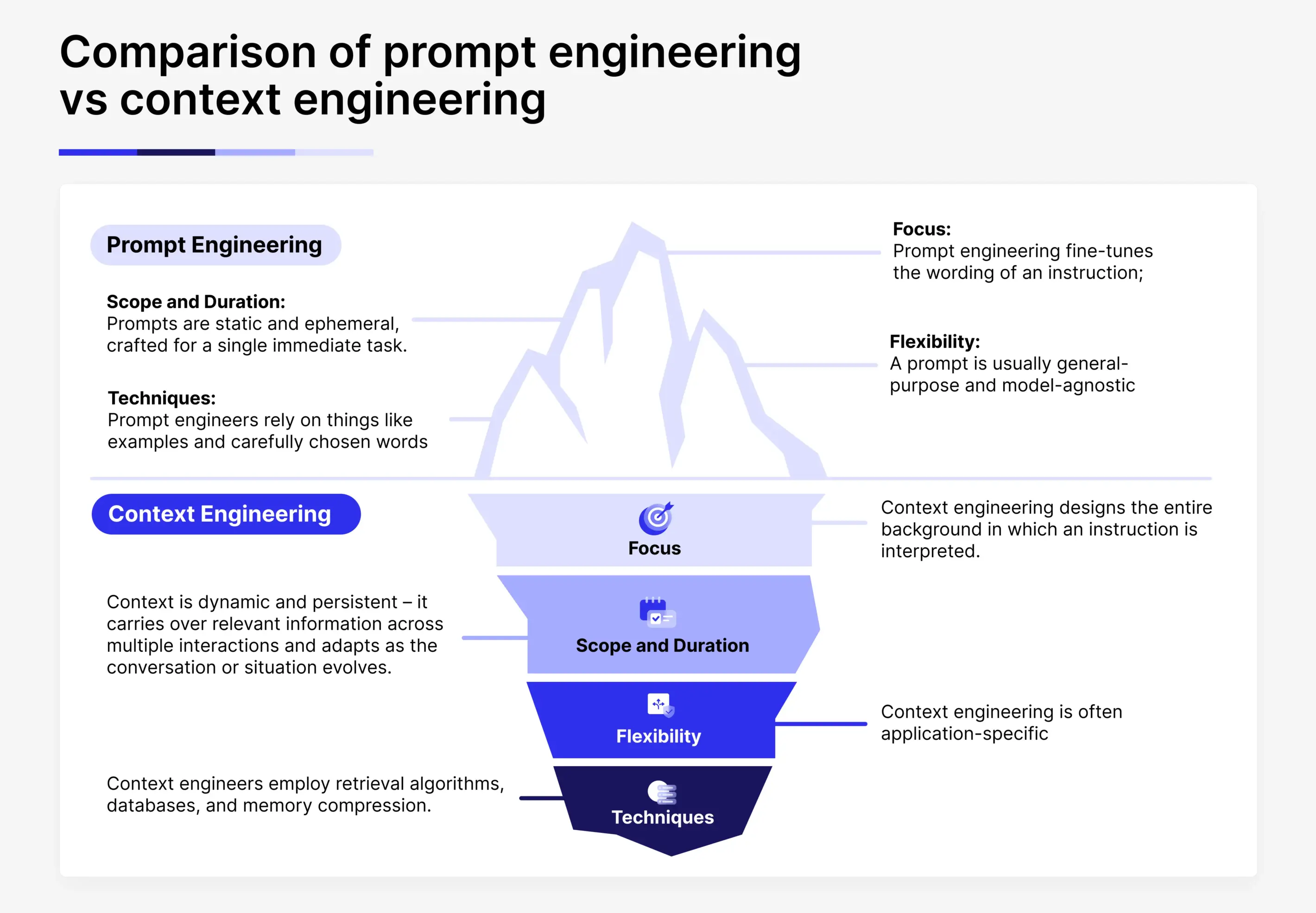
Prompt Engineering vs Context Engineering vs Harness Engineering

Artificial Intelligence has evolved far beyond simply asking ChatGPT a question and receiving an answer. As AI systems become more capable and businesses increasingly rely on them for real-world applications, new disciplines have emerged to improve how these systems perform.
For a long time, Prompt Engineering was considered the key skill for working with Large Language Models (LLMs). Then came Context Engineering, which focused on providing AI with the right information. Today, a newer concept known as Harness Engineering is gaining attention among developers building production-ready AI applications.
While these terms are often used interchangeably, they represent very different layers of AI system design. Understanding their differences is essential for anyone building AI products, AI agents, copilots, or automation systems.
What is Prompt Engineering?
Prompt Engineering is the practice of designing instructions that guide an AI model toward producing the desired output.
Think of it as learning how to communicate effectively with the model.
A prompt can include:
Instructions
Examples
Constraints
Formatting requirements
Role definitions
For example:
"Act as a senior software architect. Explain microservices to a beginner using simple language and practical examples."
The quality of the output often depends on how clearly the request is written.
Why Prompt Engineering Matters
A well-crafted prompt can:
Improve response quality
Reduce hallucinations
Control output format
Improve consistency
Reduce token usage
Prompt engineering became popular because it offered immediate improvements without requiring model training or infrastructure changes.
Limitations of Prompt Engineering
Despite its importance, prompt engineering has limitations.
A prompt alone cannot:
Give the model access to private company data
Remember previous conversations indefinitely
Connect to external tools
Retrieve real-time information
Handle complex workflows
This is where context engineering enters the picture.
What is Context Engineering?
Context Engineering focuses on supplying the right information to the model at the right time.
Instead of asking:
"How do I make the AI answer better?"
Context engineering asks:
"How do I ensure the AI has everything it needs before answering?"
The quality of an AI response is often determined more by the context it receives than the prompt itself.
Examples of Context Engineering
Context can include:
User profile information
Previous conversation history
Company documentation
Knowledge base articles
API responses
Database records
Real-time data
Imagine a customer support chatbot.
Prompt Engineering:
"You are a helpful support agent."
Context Engineering:
Customer account details
Recent support tickets
Subscription plan
Product usage history
Internal troubleshooting guides
The chatbot can now provide personalized and accurate responses because it has access to relevant information.
Why Context Engineering is Becoming Critical
Modern AI systems increasingly rely on Retrieval-Augmented Generation (RAG), vector databases, memory systems, and external data sources.
In many production applications, the challenge is not writing a better prompt but deciding:
What information to retrieve
How much information to provide
When to provide it
Which information is most relevant
This is the core responsibility of context engineering.
What is Harness Engineering?
Harness Engineering takes an even broader view.
Rather than focusing solely on prompts or context, harness engineering focuses on orchestrating the entire AI system.
Think of it as building the framework that surrounds the language model.
If Prompt Engineering is writing instructions and Context Engineering is providing information, Harness Engineering is designing the environment in which the AI operates.
Components of Harness Engineering
A harness may include:
Prompt management
Context retrieval systems
Tool calling
Agent workflows
Memory management
Evaluation pipelines
Monitoring systems
Human feedback loops
Security controls
Cost optimization
The harness determines how all these pieces work together.
Real-World Example
Imagine building an AI coding assistant.
Prompt Engineering handles:
Coding instructions
Response formatting
Coding standards
Context Engineering handles:
Project files
Documentation
Repository structure
Previous code changes
Harness Engineering handles:
GitHub integration
Code search tools
Memory systems
Validation checks
Error recovery
Monitoring
User feedback collection
The harness ensures the entire system operates reliably in production.
The Evolution: Prompt → Context → Harness
The AI industry has gradually shifted its focus.
Phase 1: Prompt Engineering Era
Early AI users believed better prompts solved everything.
Typical mindset:
"If the answer is bad, rewrite the prompt."
Phase 2: Context Engineering Era
Developers realized the model often lacked the information needed to answer correctly.
Typical mindset:
"The model cannot answer what it doesn't know."
Phase 3: Harness Engineering Era
Organizations discovered that prompts and context alone are insufficient for production-scale AI systems.
Typical mindset:
"AI performance depends on the entire system, not just the model."
This shift mirrors traditional software engineering, where success depends on architecture, workflows, integrations, and reliability rather than individual functions.
Comparing Prompt, Context, and Harness Engineering
AspectPrompt EngineeringContext EngineeringHarness EngineeringFocusInstructionsInformationSystem orchestrationGoalBetter responsesBetter understandingBetter overall performanceScopeSingle interactionInformation flowEntire AI applicationComplexityLowMediumHighCommon ToolsPrompts, templatesRAG, memory, embeddingsAgents, workflows, monitoringPrimary QuestionWhat should I ask?What should the model know?How should the whole system work?
Which Skill Matters Most Today?
The answer depends on what you're building.
For casual users:
Prompt Engineering remains valuable.
For AI application developers:
Context Engineering is often the biggest performance multiplier.
For teams building enterprise-grade AI products:
Harness Engineering is becoming the most important skill because it combines prompts, context, tools, evaluation, security, and workflow design into a unified system.
Many successful AI products today are not winning because they use a better model. They are winning because they have built a better harness around the model.
Final Thoughts
Prompt Engineering introduced the world to practical AI interaction. Context Engineering showed that information quality often matters more than instruction quality. Harness Engineering now represents the next stage of AI development, where the focus shifts from the model itself to the complete system surrounding it.
As AI applications become more sophisticated, developers who understand all three disciplines will have a significant advantage. The future of AI is not just about writing better prompts—it is about designing smarter contexts and building robust systems that allow AI to operate effectively in real-world environments.
In simple terms:
Prompt Engineering tells the AI what to do.
Context Engineering gives the AI what it needs to know.
Harness Engineering ensures the entire AI system works reliably.
The most powerful AI products combine all three.